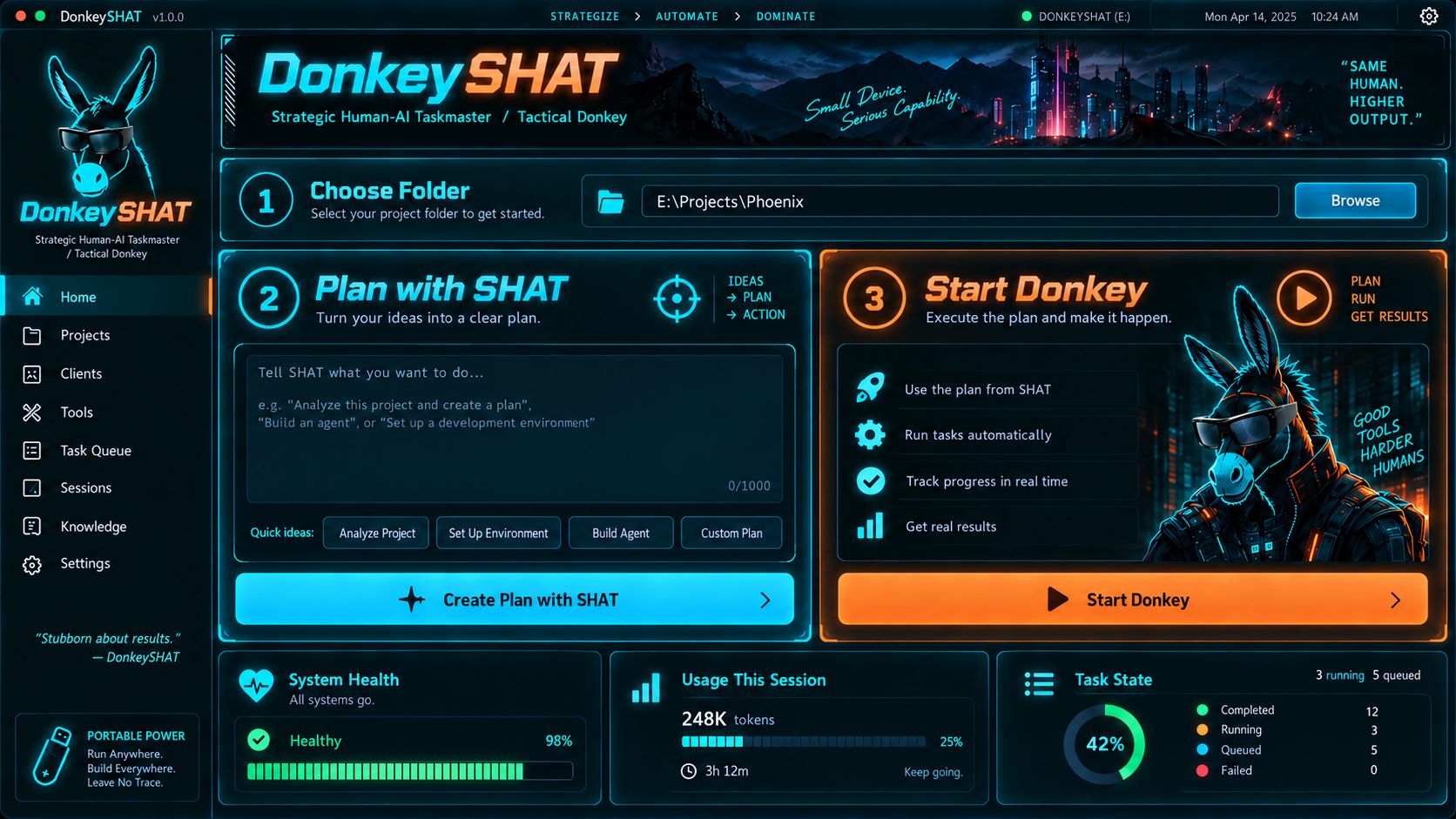
1 / DonkeySHAT
Strategy, bridge, execution
SHAT is ChatGPT Chat mode: the strategy and planning partner for shaping goals, coordinating work, creating images, preparing scripts, and turning ideas into clear instructions.
Donkey is Codex CLI: the execution engine for carrying out those instructions through focused implementation, tests, and evidence.
DonkeySHAT is the bridge: a portable operating environment connecting SHAT's direction to bounded Donkey work, live results, and controlled replanning.
2 / Why two models
Lower usage, another set of eyes
Usage advantage: SHAT is ChatGPT Chat mode and uses 0% of the shared Codex / ChatGPT Work allowance for planning and strategy. In my experience over many months, using SHAT to plan and orchestrate while keeping Donkey focused on bounded execution has kept me within my Plus limits. Donkey-heavy workflows, where Codex / Work handles both planning and execution, repeatedly hit those limits. The result depends on maintaining that balance; it is not a guaranteed percentage saving for every task.
A second opinion: SHAT brings a separate model perspective to Donkey's plan, progress, and results. It can help spot do-loops, unnecessary tool calls, repeated failures, or scope drift, and recommend stopping or replanning before more usage is wasted.
4 / Next major milestone
Full DonkeySHAT mode
In development: SHAT plans → DonkeySHAT converts the plan into bounded execution work → Donkey executes → live Donkey events return through DonkeySHAT → SHAT and the user observe execution → repeated failures, loops, scope drift, or wasted work can trigger a pause and replan.
The intended bridge removes manual copy/paste between SHAT and Donkey, provides a shared live event stream, and enables controlled intervention and replanning. This bridge is not complete yet.
6 / GUI direction
Dual-pane control surface
SHAT side: operating mode, task objective, planning context, tools, and execution contract.
Donkey side: execution controls, execution profile, live active task, progress, and output.
Shared operational panels: project/client selector, task queue, logs, usage, tools and agents, Git state, USB health, and portable-state information. The planned architecture also includes an embedded SHAT browser/profile on USB.
8 / Portable platform
Current and expanding
Current: Portable Git, External-Git support, and a USB-first project/runtime layout.
Planned / expanding: shared tools catalog, proprietary-source mode, deliverables/build/version metadata, USB encryption, tool updater, skill updater, agent updater, and plugin updater.